
I don’t know when it happened, but I’ve evidently become a lot more sensitive to media concerning the separation of families, the arrival and perpetuation of needless pain, and the cruelty of humans towards animals and our own kind. Maybe it was around the time Trump entered office. Maybe it’s been something I’ve been developing over time, given the amount of stories we’ve seen about racism, transphobia, homophobia, misogyny, and more rights violations splattered across our screens every hour of every day for the past feels-like-forever. All I know is it’s taken its toll gradually on what I can handle these days–a fact that hit me upside the head yesterday when Mr. Fox and I settled in to watch Nausicaa of the Valley of the Wind for one of his academic assignments. Since today’s Saturday and that means another Tail by the Foxfire, I figured what better time to jump into this change in endurance and examine it alongside another piece of media I’ve been kind of putting off engaging with lately: Final Fantasy XIV: Stormblood.
What is Nausicaa of the Valley of the Wind?
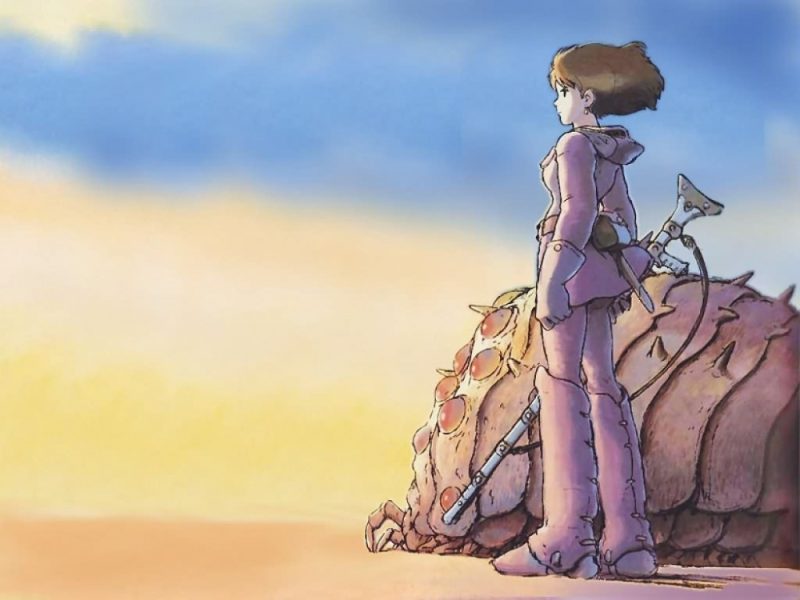
Nausicaa of the Valley of the Wind is a 1984 post-apocalyptic fantasy film written and directed by Hayao Miyazaki. In short, following an apocalyptic conflict, the small amount of remaining humans live in a toxic jungle dystopia supposedly inspired by Frank Herbert’s Dune, (with some reviewers going so far as to call it “anime’s answer to Dune”) with the titular Princess Nausicaa hailing from the Valley of the Wind. Nausicaa is special for a lot of reasons–she’s kind and gentle despite the harsh reality of the world in which she lives, thinks first of peace and harmony instead of bloodshed and aggression, seeks to understand the jungle and hopes for a way for it and humanity to coexist, and she has the ability to communicate with the gargantuan Ohm–towering, trilobyte-like insects who are perceived by humanity as a threat to be destroyed.

It’s an incredible film, painstakingly and purposefully animated (as expected of anything Miyazaki) to bring Nausicaa’s world to life and chooses its colour palette very carefully. Nausicaa traverses her sprawling world of stone, and fire, and spore with her gentle blue and white colour scheme that starkly contrasts the aggression of those around her but feels right at home in both the purity beneath the Sea of Decay and the valley itself before the Tolmekians seize it. From the very start of the film, she is a soothing influence on those around her, calming Teto and the stray Ohm, and eventually going on to influence the hearts of everyone with whom she comes into contact. Despite all of the atrocities she sees committed though, she does not let hatred or violence consume her, aside from one moment of shock where she loses control, attacks the invading Tolmekians, and ends up drawing blood from swordmaster Yupa (a dear friend of her family) inan example of how blind rage and revenge only end up hurting us and those dear to us in the end.
Following this, Nausicaa embraces a pacifist role and sets out to challenge and oppose the conflict in the hearts of those she encounters, always choosing kindness whenever it can be chosen, and helping those in need of it no matter what they have done or where they are from–for instance, she Tolmekian princess instead of killing her in revenge or letting her die in a flaming crash as many would likely be tempted to in Nausicaa’s position. Through Nausicaa’s eyes we see the complexity of the conflicts she witnesses, and the layered nature of the human spirit, which exists in a grey state of tough choices rather than only being definitively ‘good’ or ‘evil’.

It’s a many-layered film with a lot of subtext worth examining, so it’ll likely crop up by the Foxfire now and then even though I couldn’t make it the whole way through. This impact only highlighted its importance to me, as a noteworthy aspect of it was how it made me question, “but why?” whenever certain choices were made: the invasion of the valley, its subsequent seizing, the valley’s choice to surrender to them, the fight against the Ohm, the burning and chopping of the forest…
Why do we do this? Why do so many of us need violence? Why can’t we live in peace?
Why I Couldn’t Finish It, at Least for Right Now
Truthfully, Nausicaa is a film that’s very raw right now specifically, but that’s also why it’s more important than ever. We find ourselves in the midst of another bloodsoaked moment, on the brink of what could be another worldwide conflict, and in a reality where mistreatment, murder, and the robbery of rights is a daily event–a disturbing “fact of life”. Maybe in a better future I’ll be able to watch Nausicaa from start to finish again and appreciate it as a fantasy/sci-fi classic, but at the moment, it hits too close to home. Even if I couldn’t finish watching it though, I knew I had to think about it. Rather than sweep it under the rug, I wanted to interrogate just why it made me uncomfortable and honour that; I wanted to urge you to at least try to watch it so you can view it through today’s lens and mull it over, too.
The part I almost quit at was the innocent baby Ohm being torn from Nausicaa’s hands by her father, destined for execution purely for being what it was. The part I turned away from was with the Pejite’s torturing of the baby Ohm to lure a horde of adults towards the valley. This was just too much for me to stomach, but we’d seen in Nausicaa’s interactions that the very same Pejite people were capable of kindness and generosity. Strangely, it reminded me a bit of Operation Mi’ihen from Final Fantasy X where this very same tactic is used by the Al Bhed and the Crusaders because they think it’s their only hope of stopping Sin and saving the world from further destruction. I didn’t pity the Sin spawn in Final Fantasy X, but I did pity the Ohm because I saw it as Nausicaa saw it–without me even realising, her resolve and empathy reached me too, and shared with me some of the pain she must have felt watching the Ohm suffer, helping me to empathise with it even though by all appearances it’s just a bug–not fluffy or cute or expressive like Teto, but Nausicaa saw the soul in it. In her eyes, it was another innocent tortured and made to bleed, and this was no less true just because it wasn’t human.

Perhaps it’s because she’s seen so much cruelty and its destructive consequences that Nausicaa chooses to be a force for peace, hope, and unity–more violence won’t solve anything and will only deepen the rift that she hopes to repair, and besides which, where would it end? More wars will only continue to scar the world and ruin what little they have left, irreparably condemning it beyond what people like Nausicaa can possibly bring back. More casualties would only breed more cruelty, more violence, more thirst for revenge, more striving to make bigger weapons that do more damage to both humanity and the ecosystem, and humanity would eradicate itself entirely–an event that might be the only way to secure the time the earth needs to heal, if it can ever fully bounce back from what mankind’s conflicts have committed, but which doesn’t feed the hope for which Nausicaa and so many of Miyazaki’s heroes strive.
We should want to thrive hand in hand with our world, and with each other. We should want to do better. But even with the growth of Nausicaa’s seed and the seemingly happy ending as the valley is rebuilt, one has to wonder: what will the future hold once the camera turns away? Will people adopt Nausicaa’s unity with nature and love for her fellow man, or will they forget once this conflict becomes a page in their history–something unthinkable that happened long ago, and that couldn’t possibly happen again?
Where does Final Fantasy XIV: Stormblood Come In?
This might feel like a bizarre choice, but I got to thinking about Stormblood once I’d had some time to process Nausicaa and its wartime imagery and the desperation of the people trying to survive through the Ohm, the Sea of Decay, and the Tolmekians. I thought of the people of Doma and Ala Mhigo and their rebellion against the Empire’s rule and the tyranny of their leaders. We see bits and pieces of this story thread woven throughout the previous story quests, but it comes to the fore in Stormblood, which for the longest time has been the expansion pack I’ve had the most trouble with. Not because it’s bad by any means, but because much in the same way as Nausicaa, it was just hard to handle.

As the Warrior of Light, we’re used to cutting down any villain who dares to raise a hand against us or the common folk, but in Stormblood, we’re introduced to a need for subtlety that shackles us even in the face of human rights violations committed right in front of our eyes. We can’t just run up to Yotsuyu and murder her outright for her oppression and hatred of the Doman people–that would just have them seized, cut down, or tortured by her guards and any Garleans who find out what happened. The cost would be on the people, not on the Warrior of Light, just as the cost would have been on the people of the valley if Nausicaa had kept fighting the Tolmekian threat. There’s deep pain in being made to stand by, and bear it, and be patient. There’s deep pain in seeing the Domans lose hope and be made to endure it while their homes are ravaged and their families are bled. But, as is the nature of the genre, we at least know we’re going to get to bring the fight to Yotsuyu later; we know we’re going to get to go over her head and fight against Zenos. We’ll get to make it right by blood and by blade, the bad guys will suffer, and the people (like Fordola and to some extent Yotsuyu) caught in their system and their cycle of cruelty will be given a chance to leave it and repent, whether that’s by deed or by death.

Stormblood ends on a more overtly hopeful note than Nausicaa, with Lyse returned to help rally her people and Hien back in his rightful place as Doma’s reigning lord. Times look better, the rebuilding effort has begun, and the Garleans are driven out. By the power of belief, and friendship, and sheer determination, we help win the day and secure a definitively brighter future. It’s all wrapped up in a bow, for the most part, or so it feels. Still, despite this, it’s still a hard one to come to on subsequent replays. Unlike its predecessors, Stormblood’s threat feels much less fantastical and far more human, even off the back of Heavensward wherein mankind twisted dragonkind into an enemy to be hated rather than living beings with whom we should coexist. There are parallels with Nausicaa here as well, but again, the evil is ousted and repairs are made to strive for a brighter future. It feels decisive. It feels complete. For now at least, there’s little fear that our deeds will be undone, and if they are, we’ll just bring the bad guy down again in the inevitable and exciting sequel.
Hope and the Role of Control
I have to wonder if it’s the medium of gaming itself which helps here, and express that it makes a wonderful case for the encouragement of empathy in gamers rather than the accusations of violence the media so loves to make. A big difference between Nausicaa and Final Fantasy XIV is the ability to take control of the protagonist and be a force for change. Rather than watching and hoping that Nausicaa will succeed, we’re an active part of the rebellion, helping those who need it and working hard with our allies to knock down the oppressors and wrongdoers who threaten the peace. It’s entirely in our hands whether victory will be won, and we celebrate it with our party members when we land the final strike. The credits roll. Everything’s okay.
When I saw that baby Ohm suffering though, and when I saw the one snatched out of Nausicaa’s hands in her flashback, what I felt was helplessness. That was the truth at the heart of it, that was the part that hurt most deeply. Horrible things were happening and there was nothing to be done–it’s not like Nausicaa (or we, for that matter) can bossfight her problems away. The laws of her world don’t work like that. What powers she has are communication-based, not magical forces that can even put her on par with the heavily armoured Tolmekians, let alone help her vanquish them. There’s no deity whispering in her ear that she’s doing the right thing, there’s no party of Good Guys to throw her a magic Key Item, no armies she can band together with against the common foe, no malicious god pulling the strings that she can bring down to solve all her conflicts–she’s just one girl, and she has to figure out for herself what’s right and what part she can play to maybe make a difference. It’s for her to hope that, even as the years go by, that difference will be enough.
Just the same as any of us.

If you enjoyed this blog, please consider subscribing so you can be alerted whenever I post content!




Leave a Reply