
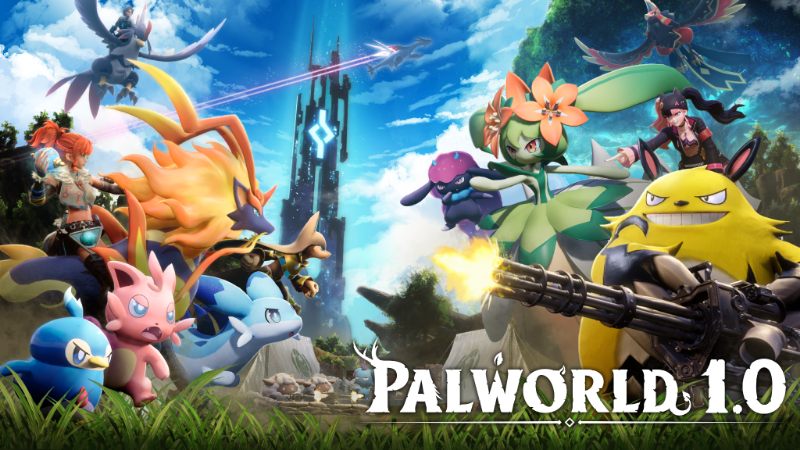

Tails by the Foxfire’s Deep Dive Into Palworld, Pokemon, and the Ways in Which Video Games Feel Like Home
My hometown is slowly dissolving, Palworld just released the highly anticipated 1.0 patch, and I’m preparing to move halfway around the world, back to the place my wife was raised. Those things might seem disconnected, even overly heavy for an opener, but stay with me: they connect, and it’s not horribly depressing, I promise.
When I started playing Palworld 1.0 across two different files with close loved ones, I felt something I hadn’t felt in gaming in a long time: I was genuinely curious to manually discover everything myself, with as little research and pre-reading as possible. It felt like I was experiencing the game for the first time again, which is something I’ve been chasing as a gamer, and particularly as a Pokémon fan for a long time. It made me think about the metaphorical homes we make for ourselves inside the music of a certain band or the IP of a studio; the little ways that a song or a game or even a book can feel like a refuge that we come back to repeatedly, especially when life is uncertain or difficult.
Keep reading as I take you on a whirlwind tour of 30+ years of Pokémon journeys, why the series brought me comfort in my darkest days, and the ways that Palworld reinjected a sense of wonder that shook things up and helped me feel at home during a turbulent time in my life.
Read More Video Game Deep Dives at Tails by the Foxfire
Video Games & Nostalgia: You Can’t Go Home Again… Or Can You?
Pokopia & PCOS: How Rebuilding the Pokémon World Helped Me During My Health Crisis
My Toxic Relationship with The Legend of Zelda: Breath of the Wild
Stardew Valley, Cozy Games, and Making Time for the Things You Need
How Final Fantasy XIV Helped Me Fight Agoraphobia, One Dungeon at a Time
Pokémon & Totodile: My Safe Spaces in a Troubled Childhood
I first experienced Pokémon not long after the North American release of Red and Blue in 1998, on a hand-me-down Gameboy. I was still pretty young, first experiencing the series when I was in elementary school. I rapidly fell in love, and I still feel compelled to interact with the series today. I didn’t have the easiest childhood. Like many people in my life, I was living in a difficult socioeconomic position with a complicated family and going to public school and struggling to fit in. I moved around a lot, and lived in most of the places someone can live between my hometown and the city I live in now. Pokémon quickly became a place of escapism and refuge that grew up with me. I spent the most time, probably, with Generation 2. Johto was my safe place and seeing Totodile return in Pokémon Z-A was genuinely moving. My little guy had come back to me, and he was finally getting some much-needed love from The Pokémon Company (TPC).

Pokémon From Z-A: Why Do Current Generation Games Feel Different?
Unfortunately, Pokémon Legends Z-A was a bit of a “you can’t go home again” experience for me, not unlike actually visiting my hometown. I felt the same kind of loss trying to play Z-A that I felt walking into the empty malls and closed up shopping areas of my childhood. A lot of people had fun with it, and I’m very happy that they did. I like to see TPC succeed. For me though, it felt like a lot of the things that I had grown up with had been gutted, and the live-action combat in Legends Z-A was compelling and interesting for a couple hours before I realized that I missed the theoretical exercise of building a new team, navigating typings, movepools, and abilities. It felt like places I had recognized for years were suddenly gone, and it’s a feeling that started not long after the shift away from sprites on the Nintendo DS. Pokémon Legends Z-A is the most stark example of this, but it’s not the only time that I felt that, in coming back to my “home”, something had been moved or changed in a way that made me uncomfortable with my surroundings. If I think about games I never finished, only a few Pokémon generations make the list, and all of them are from that later period in their production. Similarly, Pokémon Champions created an amount of worry that my home was going to change dramatically. Rather than trusting players to figure the games out, like The Pokémon Company has for years, it felt like they were taking much of the layered, theoretical team building and relegating it to a PvP only experience. For me the experience of Pokémon was about the narrative, the experience of building my team carefully, and overcoming impossible odds with them.
The move to 3D models also changed something that I never quite recovered from. I can’t quite put my finger on it, but when I think of the games that I had the most fun with, that felt the best, it often goes back to the first three generations and the spriting that made up the majority of the art. Even the later handheld games that used modeling over spriting were more evocative of the originals. As a longtime fan of Pokémon, and in spite of some absolutely brilliant monster designs and typing combinations, I felt the least connection with games like Pokémon Sword and Shield, or Pokémon Scarlet and Violet. The Legends games, and so far the future of Pokémon in games like Champions, GO, and others, have nearly completely lost me.
Putting it all together, I just never really got into the newer titles the way I did the older ones, sometimes to the point of never finishing them. I loved remakes like Pokémon HeartGold and SoulSilver, or Pokémon Omega Ruby and Alpha Sapphire. Since then, finding that feeling of home has been difficult. In some ways, it feels like going home again for the first time in years. The shops are there, the mall is still standing, but there is an emptiness and an unfamiliarity that prevents me from staying too long. The last time I was home, the malls and other social spaces of my hometown were steadily going out of business. Workplaces were shutting up shop, stores I had visited my whole life had closed, and public spaces were a wasteland nearly entirely devoid of people despite having once been the preeminent shopping spaces in town. I come from a small town in the country, so it was shocking to see the changes. Other places, thankfully, had been revitalized, but there was a strange hollowness in seeing that everything was the same as I remembered it but…emptier. The places I had felt a sense of belonging to still existed, but they had changed, in some cases turning into hollowed out, empty shops.

What Pokémon Stands to Learn: How Does Palworld 1.0 Breathe New Life Into the Creature Capture Genre?
It’s not all doom and gloom though, and as I mentioned I found this sensation of being home again in Palworld’s 1.0 release. When Palworld released their finished game with 1.0, the core of the game remained the same, and I wasn’t asked to learn a new gimmick just because the game was being changed. I was able to interact with new Pals right away, and changes to older Pals’ abilities meant that even when I knew them and their capabilities, there were surprises to be had. NPCs interacted with me differently than they used to, and more story had been made available to me. It made me wonder what newer Pokémon games could gain from a back-to-basics approach where they focus on the core mechanics, rather than the generational gimmick. It’s also possible that the internet has just ruined Pokémon for me by ensuring that every mystery is uncovered right away, or that the newer games being a bit more linear despite being more open world than Pokémon has ever been have an impact. It’s likely, rather than pointing to a single cause, that all of these together have given me a world to explore with mysteries to discover, and a focus on what the game knows it does well, and that’s enough.
What struck me most about Palworld, and why I felt compelled to hold it in conversation with Pokémon, however, was that they didn’t make huge sweeping changes to the mechanics of the game. It still felt like the survival crafting Pokémon-adjacent experience it had felt like during Early Access. I recognized much of the game, they had just added some crucial new elements. An expanded late game, which I have yet to arrive at, was chief among these, but I was able to see the new elements straight away. New Pals showed up in the early zones, and Pals I had gotten to know in the Early Access had new abilities and an increased proficiency cap that would allow them to get even better at their base tasks. This new coat of paint early was enough that it didn’t feel like a chore to rebuild from scratch, following the recommendations of the game’s developer. The structure was familiar, but, to liken it to my experience going back to my hometown, I could see that new places were appearing, and old standards had renovated rather than closing.
In holding those two games in conversation I think it highlighted something that I struggled with in newer Pokémon games, starting on the Nintendo DS. I felt like there was an attempt to always have a new, shiny mechanic that changed the way the player operated in the world. Some of those were good, or at least vocally very supported, and some of them were not. Noticeably, however, they were almost always done away with in the next generation for good. I wondered, while I was thinking about this feeling of being at home in a changed Palworld, if it was this instability that made me feel less at ease in newer Pokémon titles. Maybe, like Palworld, Pokémon just needed a fresh coat of paint. New Pokémon, revisitations to old ones. I have heard from many other fans that things like rebalancing older Pokémon to suit the power levels common in newer games would excite them. I personally was a big fan of regional forms and alternate versions of older Pokémon. This was one of the most exciting changes in recent years for me alongside Mega Evolution, and I would love to see more of it. I would also have loved to see adjustments to abilities that acknowledged the world, rather than just the battling system.
Flame Body making eggs hatch faster was a cool example of this and a discovery that I loved. Seeing more of that might have been, and could be, interesting. To explore that potential further, what if a Snow Warning Pokémon could create snowy weather, and thereby change the spawn table for a given area? Modern hardware could surely support this, especially if we de-emphasized pushing the graphics envelope. Models don’t need to be even more complex if the game mechanics are engaging, as we’ve seen with the recent success of indie titles such as Stardew Valley, Dark Deity, and even critically acclaimed Hades and Hades 2. These games aren’t pushing the envelope of graphics capability, or even mechanical capability. They know what they want to do, and they do it wonderfully. The same level of care, in my opinion, would have helped with Pokémon’s development rather than what, at times, feels like throwing spaghetti at a wall to see if it sticks.

Palworld vs Pokémon Verdict: Why Pokémon Still Holds My Heart as I Take on Life’s Challenges
All of this to say, again, that I don’t have a particular preference for one or the other. My renewed excitement doesn’t mean I favour Palworld over Pokémon, and I will probably still shill for TPC at every opportunity simply because that childhood nostalgia is still alive and well in merchandise, fan games, and seeing reimaginings of my childhood friends in newer mainline games. It just means that the new generation of Pokémon–Pokémon Winds and Waves–may or may not be for me; I’ll find out on release day! If I were to profess a preference, I would probably say that my childhood nostalgia still leans in the direction of Pokémon over Palworld despite my criticisms. Palworld has given me hope though, that I can find a similar feeling in new places if TPC continues to change the games in a way that makes them less familiar and comfortable for me personally. That hope is important, as I’m in the process of winding down my education and moving to a country I have never lived in.
As I mentioned before, my wife and I are preparing an international move back to her hometown, where we will be closer to in-laws, friends, and systems that give us a better shot at success, and while that’s exciting, it also carries some of the complex feelings of making a new place home for me, and discovering that home might not be as comfortable and familiar as it once was for her. I like to believe though, that small-town living and going home again doesn’t have to be an entirely painful or uncomfortable experience, and I think sitting with the Pokémon/Palworld comparison has helped me process my feelings on this move in a way that has left me hopeful and forward-looking. I’m starting my own adventure, just as Pokémon inspired in me as that kid back in ‘98 who hoped and longed for a better life. I don’t know if my new home will be what I need, but I’m excited to find out, just as I don’t know if future Pokémon generations will feel like home, but I’m learning to find home in new projects like Palworld, and other indie titles that pay close attention to what fans love about them and how homes are made in a new IP. If I really, really miss my metaphorical home in Pokémon, there’s always fan projects to make the familiar new and exciting again, too. If nothing else, it will still have a place in my life, whether it’s in the form of fan projects, merchandise, new mainline games, experiments like Pokopia, or just the memories I had of those long-ago days with my gameboy.

Video Game Deep Dive Essays, Reviews, Previews, and Quickstart Guides at Tails by the Foxfire
It was such a joy to welcome The Sly Scribe to the Foxfire as a guest writer for this walk down memory lane, and we’re so excited to have him by again soon for more in-depth video gaming talks, so make sure you subscribe below to make sure you get alerted as soon as we post new video game reviews, indie spotlights, quickstart guides, and deep dives! What are your feelings about Palworld vs. Pokémon? Have you felt the same fatigue and disorientation on your latest Pokémon journeys, or have you been team Palworld from the start? Drop a comment below to join the conversation and let us know your thoughts!
Are you a dev or PR representative seeking partnership opportunities? Look over our official press kit and get in touch via email or contact form, or find us on Keymailer or our Steam Group, where you can also browse our curated game recommendations!






Leave a Reply