

Tails by the Foxfire’s 25th Anniversary Retrospective of Final Fantasy X
Final Fantasy X was among the games that started it all for me, as far as my appreciation for video games goes. We’ve talked before about how the classic Tomb Raider was is a core memory (no pun intended) of mine from watching my brothers play it on the Sega Saturn back in the 90s, but Final Fantasy X was, alongside Kingdom Hearts, formative for me in that it was one of the first games I put hands on once my brothers moved on from gaming. Not only that, it was a demonstration of video game innovation that felt revolutionary at the time, a story scope that subverts tropes posited by Campbell’s traditional Hero’s Journey, and as a result, was wholly unlike anything I’d ever seen up until that point.
At 11 years old when Final Fantasy X first released in Europe in May 2002, I had no idea that Tidus’ coming of age as a fish-out-of-water and Yuna’s fortitude on her pilgrimage would have on my emotional maturity in the years to come, and how the game would play a crucial role in galvanizing myself against life’s challenges like the loss of loved ones, the transitional periods of finding my social place in the world, navigating social anxiety, depression, shifting friend groups, managing a long-distance relationship, and an eventual move halfway across the world. There have been good times and there have been misfortunes for me in these 25 years, but Final Fantasy X was there through it all to help me see each bump in the road as a lesson that led me to the person I am today.
Keep reading as I celebrate Final Fantasy X and why I think it’s such a mainstay in the contemporary video game landscape 25 years later, and remember to subscribe to Tails by the Foxfire for more video game essays and deep dives!
Read More Video Game Deep Dives at Tails by the Foxfire
Palworld, Pokémon, and the Feeling of Coming Home Again
Pokopia & PCOS: How Rebuilding the Pokémon World Helped Me Through 40 Days of Blood, Fatigue, and Brain Fog
How Final Fantasy XIV Helped Me Fight Agoraphobia, One Dungeon at a Time
Is Final Fantasy X a Good Starting Point in the Series?
The great thing about Final Fantasy as a series is you can start just about anywhere, as most of the games are standalone with a handful of unintrusive references. Final Fantasy X is no exception, and was actually my introduction to the series with its simple yet satisfying tag team system and relatively straightforward sphere grid levelling system (well, simple once you understand it, which I help out with in my Quickstart Guide here because I struggled with it too all those years ago).
Final Fantasy X/X-2 HD Remaster Trailer
Why Does Final Fantasy X Still Have One of Final Fantasy’s Best Battle Systems?
Final Fantasy X uses the Conditional Turn-Based Battle (CTB) system which bases turn order on character speed stats. The faster a character is, the sooner and more often they can move. Final Fantasy X also offers a mechanic that I wish would make a return in more modern games, as it’s probably my favourite battle system from across the series: the tag team system that lets you switch characters in and out of your party during combat, allowing you to turn the tides of each battle on the fly by changing your lineup as soon as you need to.

Why Don’t People Like the Faces in the Final Fantasy X HD Remaster?
When Final Fantasy X was originally released for the PlayStation 2, it took full advantage of the platform to give their characters distinct voices, appearances, and expressions that let them express their emotions fully. A fact that is still mentioned in the Final Fantasy Ultimania Archive Volume 3, and that keeps players calling for a re-remaster with models trending closer to the spirit of the original PS2 version. When Final Fantasy X was remastered in HD in 2013, players (myself included) mourned the loss of the original art style: the world looked pretty good, and the HD remaster centralized international features like superbosses that certain regions hadn’t seen previously, but the new models smoothed out the defining features and beloved expressions of characters, bringing us brighter and sharper graphics at the cost of characterisation and emotion, flattening some crucial moments where subtle mannerisms and expressions had added layers to the original feel of certain lines and scenes. It was a hard trade-off, and one that I admittedly feel amending was a missed opportunity for Square when planning the recent release of the enhanced HD version for the Nintendo Switch 2. While I don’t believe the game needs the full glossy remake treatment Final Fantasy 7R style, I hold out hope (if nothing else) for Square to revisit Spira by remodelling the characters with the capabilities of current experience and tech, just as modders have for the PC release, so new gamers coming to the story for the first time can experience it and fall in love with its characters without the oddly uncanny, dead-eyed plastic look.

What is Final Fantasy X About?
Let’s get into the story. Final Fantasy X follows Tidus: a star blitzball player who is swept away to the world of Spira by a monstrous entity called ‘Sin’ who lays waste to his home city of Zanarkand. While in Spira, Tidus is just a regular guy who finds himself isolated from society: a long fall from his previous status as an idolised figure. He meets the summoner Yuna and her guardians who are on a pilgrimage to bring about another ‘Calm’: a temporary period during which Sin is dormant and the people of Spira can live in peace until Sin returns to life. Yuna is the daughter of the previous summoner to achieve this feat, and intends to honour his memory as the next one to do so. During their journey, Tidus, Yuna, and their friends will face challenges far bigger than them and find their faith shaken by the truth of Spira’s cyclical trials of death and rebirth.
Is Tidus the Hero of Final Fantasy X?
At the beginning of Final Fantasy X, we’re introduced to Tidus: the star player of the blitzball team the Zanarkand Abes, right before a match against rival team the Zanarkand Duggles. We’re given enough time to get a concise picture of Tidus’s status quo as a young up-and-coming sporting celebrity admired by the public, son of a legendary blitzball player, and living in luxury on his houseboat on the harbour of a metropolitan city before it all comes crashing down around him. In short order, monsters swarm the city, joined by a towering creature we are introduced to as ‘Sin’ by a mysterious man known as Auron, who is an apparent friend of the family, given that Tidus recognises him on sight.
Auron is effectively our Obi Wan: he bestows Tidus with his father’s sword, shows him how to fight his way through neverending swathes of enemies, and communes with Sin (“you are sure?”) before they are all transported to the world of Spira. The last thing Tidus hears before his unceremonious arrival in this new world is Auron’s voice informing him that, “This is your story.” From there, Tidus finds himself separated from Auron and Sin. He is dropped head-first into the figurative Belly of the Whale, and almost into the literal belly of the beast when he is greeted by the fearsome Geosgaeno at the Ruins: a fight for which he is woefully unprepared without Auron’s support. It’s only by his blitzball-honed skill at swimming that he’s able to escape with his life.

How Final Fantasy X Subverts Campbell’s Typical Hero’s Journey
If there’s one thing you’ve heard fans of Final Fantasy X raving about, it’s likely the story. When I was younger, Yuna’s arc spoke to me the most: she’s a fresh-faced, often naively idealistic summoner with a head full of dreams, who sets out to travel across Spira and help whomever she can on her way to bringing the Calm. She does this while bearing the weight of her father’s legacy, drawing strength from it and sometimes feeling daunted by it rather than flaunting it or resting on the celebrity status this notoriety brings her. While I didn’t relate to this momentous destiny on a literal scale, it was what Yuna stood for throughout the game that I admired: Yuna shows admirable resolve, determination, and kindness versus injustice and corruption on a global scale, and no matter how it hurts her, she always sees the world and the people in it as worth saving. I mentioned earlier that Final Fantasy X subverts the tropes of the traditional Hero’s Journey as posited by Joseph Campbell in The Hero with a Thousand Faces, and I want to clarify that I don’t mean it rejects the format entirely. Rather, Tidus’s entry into Spira and Yuna’s role as saviour play a big role in shaking up the tried-and-true format, and provide a vehicle for those extra unexpected punches to each of the game’s twists.
Square Enix and the Art of Subversion in Final Fantasy X
Everything about the opening of Final Fantasy X suggests to us that this is a standard portal fantasy wherein Tidus is the hero called from another world to save the one he arrives in, but Square Enix loves their bait-and-switch gotcha shocks. The reality, though, is that Tidus isn’t greeted as some great storied saviour: the people of Spira mostly find him kind of annoying, actually, because at best he doesn’t understand societal rules and at worst he shrugs them off completely and willingly flouts them to pursue his sense of justice. He asks a lot of questions as well, which makes people uncomfortable more often than not, as those questions usually challenge (and therefore force them to think about) why things are the way they are. Crucially, Yuna is among the people Tidus asks these questions of, but she’s open-minded and gentle enough to consider his questions seriously instead of brushing them aside with frustration or blind faith as even other key characters like Wakka and Lulu do at first. Tidus isn’t the hero in Campbell’s definition, but he’s the catalyst that gradually equips Yuna to be.
Things get really spoilery from here on, so skip straight to the end if you’d like to stay pure!
How Final Fantasy X Subverts Campbell’s Typical Hero’s Journey
If there’s one thing you’ve heard fans of Final Fantasy X raving about, it’s likely the story. When I was younger, Yuna’s arc spoke to me the most: she’s a fresh-faced, often naively idealistic summoner with a head full of dreams, who sets out to travel across Spira and help whomever she can on her way to bringing the Calm. She does this while bearing the weight of her father’s legacy, drawing strength from it and sometimes feeling daunted by it rather than flaunting it or resting on the celebrity status this notoriety brings her. While I didn’t relate to this momentous destiny on a literal scale, it was what Yuna stood for throughout the game that I admired: Yuna shows admirable resolve, determination, and kindness versus injustice and corruption on a global scale, and no matter how it hurts her, she always sees the world and the people in it as worth saving. I mentioned earlier that Final Fantasy X subverts the tropes of the traditional Hero’s Journey as posited by Joseph Campbell in The Hero with a Thousand Faces, and I want to clarify that I don’t mean it rejects the format entirely. Rather, Tidus’s entry into Spira and Yuna’s role as saviour play a big role in shaking up the tried-and-true format, and provide a vehicle for those extra unexpected punches to each of the game’s twists.

Auron as Mentor and the Rejection of False Blessings
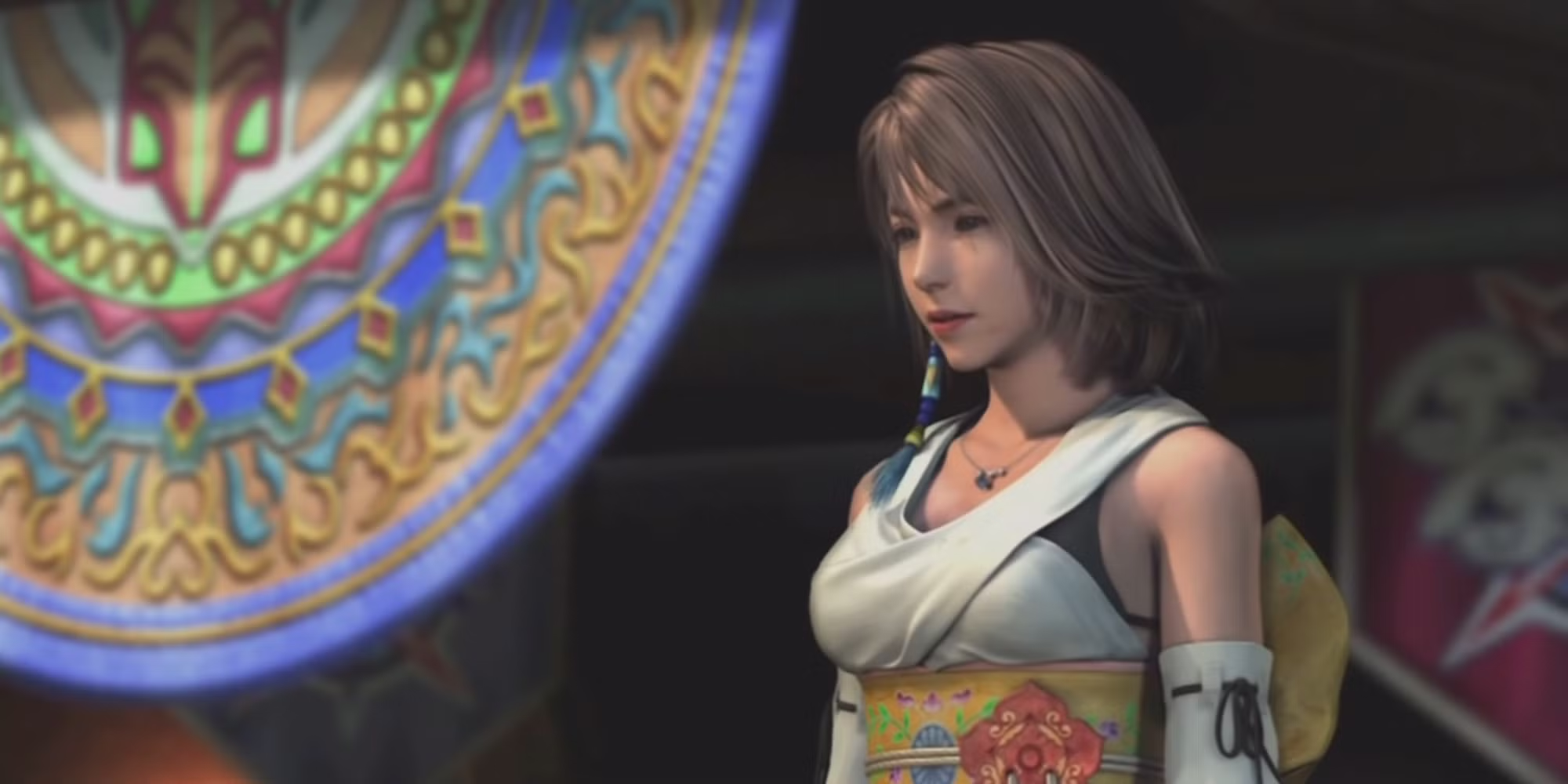
Another notable subversion that presents itself from early on in Final Fantasy X is Auron as mentor. He tells Tidus only what he needs to know when he needs to know it, but otherwise intentionally withholds the truth: he withholds the corruption of the temples, he withholds Spira’s norms and customs, encourages Tidus to ask his questions & learn by doing and making mistakes on Campbell’s Road of Trials, and in so doing, allows Tidus’s unfiltered and honest reactions to the absurdity of Spira’s passive sacrifice of summoners and guardians to shine a light on the flaws in the system, as well as those governing its continuation for their own gain. It is by doing this that Tidus and Yuna are able to think for themselves, reject Campbell’s Woman as the Temptress (Lady Yunalesca and her false blessing the familiar yet fleeting peace of the Calm in exchange for Yuna’s life and the life of one of her guardians) with her easy but temporary solution, and instead brave the harder road to win a future for Spira, its people, and for Yuna herself that isn’t lived in Sin’s shadow. While Campbell’s ‘Woman as the Temptress’ traditionally tests the hero with physical or earthly desires, Yunalesca tempts the party with something far more insidious: institutional comfort, for which the party has spent the entire game preparing until they understand what it entails. Yunalesca offers the familiar safety of a thousand-year tradition, inviting Yuna to accept a false peace rather than endure the terrifying unknown of breaking the cycle. The unknown is a scary thing, especially as Yuna hasn’t had to imagine a future that she is alive to see, but she places her faith in Spira and its people, instead of the path of Yevon (Spira’s religious system) and its keepers.
Yuna: My father… my father wanted… to make Spira’s sorrow go away. Not just cover it up with lies!
Lady Yunalesca: Sorrow cannot be abolished. It is meaningless to try.
Yuna: My father… I loved him. So I… I will live with my sorrow, I will live my own life! I will defeat sorrow, in his place. I will stand my ground and be strong. I don’t know when it will be, but someday… I will conquer it. And I will do it without… false hope.

Yuna’s Figurative Apotheosis and the Eternal Calm
With Yunalesca defeated, Yuna and Tidus abolish a thousand-year-old tradition and achieve Campbell’s Apotheosis in a figurative sense, which elevates Yuna to the status of the legendary High Summoner who brought the Eternal Calm. Successful summoners were deified as it was for their sacrifice, with their statues in the temples across Spira for people to come and pray to. Yuna’s elevation to Grand Summoner is a huge thing for her as a summoner previously labelled a heretic, especially as someone with partial Al Bhed heritage (a race of people shunned by Yevon for their innovation and aptitude with machinery forbidden by the religion). The new era has arrived in the form of Yuna’s Eternal Calm, and it’s she who inherits Campbell’s Hero’s Freedom to Live at the end of her journey.
Had Auron laid out everything from day one, it’s possible that Tidus may have just taken the tradition of summoner sacrifice at face value, but instead Auron gives Tidus the space to be outspoken and eventually, finally, help Yuna break the cycle of death that has held Spira in a chokehold for generations, saving a world that he and Tidus will not be alive to witness once the story comes to a close.
Spoilers End Here
Final Fantasy X is a Mainstay in the Video Game Landscape
Final Fantasy X’s subversion of traditional tropes and its status as a pioneer in complex soundtracks, cinematic storytelling, and complex, fully-voiced characters showed the world that video games were evolving as a medium back in the early 2000s. However, its true longevity lies in its refusal to offer easy comfort and its encouragement that we opt for the choice that is right, not the one that is easy: a message that helps us stay brave in the face of injustices like we’re living through today. By taking the classic Hero’s Journey and weaponizing our familiarity with it, Final Fantasy X delivers a story about institutional grief, the burden of inherited expectation, and the quiet bravery required to break cyclical tragedy and reject false hope and blind faith, inspiring us instead to think for ourselves, define our own ideals, envision our desired future, and strive to conquer our sorrow rather than fall to it. Its legacy can still be seen in the video game landscape today, carried by contemporary greats like Clair Obscur: Expedition 33. As well, notable figures like multi-time New York Times bestselling author Brandon Sanderson have ranked Final Fantasy X among their top favourite games of all time, so I’m in good company. As one of the richest story-based games I’ve known to date and a title that started my love of the medium, I find myself coming home again and again to Spira, and I’ve been wanting to talk about Final Fantasy X on the platform for a long time.
Happy 25th Anniversary, Final Fantasy X. To Square, the cast, and all involved, I want to express my thanks for this unforgettable journey and the bittersweet lessons it has taught (and continues to teach) me about holding on to hope in the face of loss and change and uncertainty.
“The people and the friends that we have lost, or the dreams that have faded… never forget them.”
I’ll see you again in 5 years for your 30th!



Leave a Reply